


The efficiency of CNC milling plays an important role in modern industrial production, affecting quality, productivity and manufacturing costs. The process depends on many factors, and tool geometry is of fundamental importance. The right shape, angles and dimensions of a cutter can increase machining productivity, improve surface quality and extend tool life.
Optimizing tool geometry can reduce cutting forces, effectively evacuate chips and minimize vibration. This allows for better process control and greater machining precision. Understanding the relationship between tool geometry and CNC milling efficiency contributes to a competitive advantage in the industry.
Impact of rake angle on cutting performance in CNC machining
The rake angle plays a key role in determining cutting performance in CNC machining. The angle defines the relationship between the tool’s rake surface and the plane perpendicular to the machined surface. Proper selection of the rake angle has a significant impact on cutting forces, chip formation and tool life.
Optimizing cutting forces
Increasing the rake angle usually leads to lower cutting forces. With a larger rake angle, the tool penetrates more easily into the workpiece material, resulting in less cutting resistance. The reduction in cutting forces translates into lower energy consumption and less load on the CNC machine spindle.
Too large a rake angle can weaken the cutting edge of the tool. When machining high-hardness materials, a smaller rake angle may be necessary to ensure adequate blade strength.

Controlling chip formation
The rake angle has a significant impact on chip formation and chip removal. A larger rake angle promotes the formation of thinner and more twisted chips, allowing easier evacuation from the cutting zone. When machining plastic materials, there is a risk of long, continuous chips.
Proper chip formation prevents tangling around the tool or workpiece, reducing the risk of surface damage or tool failure. Efficient chip evacuation contributes to better cooling of the cutting zone.
Impact on surface quality
Choosing the right rake angle has a direct impact on the quality of the resulting surface. A larger rake angle usually produces a smoother machined surface. Lower cutting forces and more efficient chip formation contribute to better surface smoothness.
When machining certain materials or under specific conditions, the cutting process may become vibrated or unstable, adversely affecting surface quality.
Interesting fact: Studies have shown that increasing the rake angle by each degree from 0° to 20° can lead to a reduction in cutting forces of up to 1-3%, depending on the material being machined.
Tool life vs. rake angle
The right choice of rake angle has a significant impact on tool life. An optimal rake angle minimizes tool wear, translating into longer operating time without replacement or sharpening. A rake angle that is too small can cause increased friction between the tool and the workpiece, accelerating tool wear. Conversely, too large a rake angle weakens the cutting edge, increasing the risk of chipping or fracture.
Selection of the optimal rake angle requires consideration of many factors: the type of material to be machined, the cutting parameters and the required surface quality. In practice, tools with a variable rake angle along the cutting edge make it possible to optimize the cutting process under different machining conditions.
Importance of cutting edge radius for surface quality
The cutting edge radius plays an important role in shaping surface quality during CNC milling. This micro-geometric parameter affects the interaction between the blade and the workpiece material, which directly affects the surface roughness and the integrity of the surface layer.
Impact on surface roughness
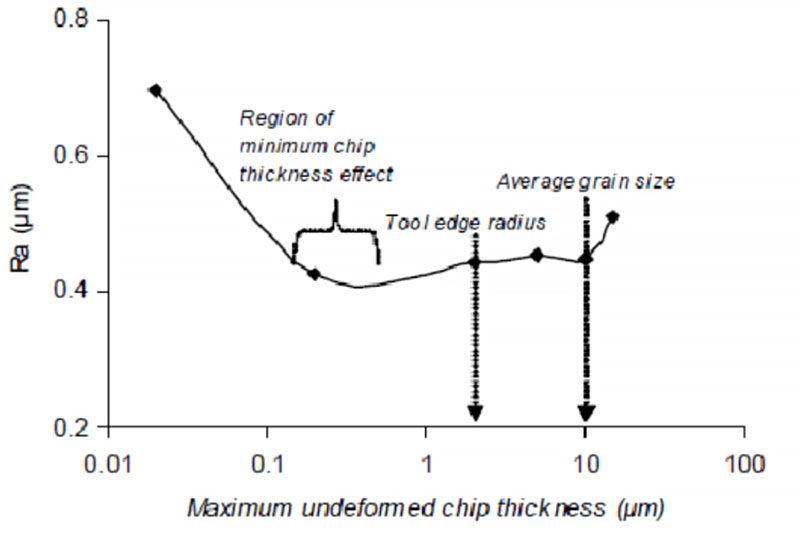
The size of the cutting edge radius affects the roughness of the obtained surface. Studies have shown the existence of an optimal radius value to achieve the lowest roughness. Smaller cutting edge radii (10-20 μm) make it possible to obtain smoother surfaces, especially during finishing.
However, too small a radius can make the cutting process unstable and cause faster tool wear, leading to deterioration in surface quality. On the other hand, too large a cutting edge radius can induce greater plastic deformation of the workpiece material, which also negatively affects roughness.
The effect of the cutting edge radius on surface roughness also depends on the ratio of the radius to the thickness of the cut layer. If the cutting edge radius exceeds the minimum thickness of the machined layer, part of the material may undergo plastic deformation instead of being effectively removed, leading to a deterioration in surface quality.
Integrity of the surface layer
The radius of the cutting edge has a significant impact on the integrity of the surface layer of the workpiece material. A larger radius usually results in deeper deformation of the subsurface layer. In some applications, this effect can be beneficial when strengthening of the surface layer is required. In other cases, where minimal deformation is required, too large a radius can be problematic.
Studies have shown that increasing the radius of the cutting edge can lead to:
- an increase in the depth of the reinforced layer,
- an increase in compressive stresses in the surface layer,
- changes in the microstructure of the material in the near-surface zone.
The effects can have both positive and negative consequences, depending on the specific application.
Optimization of the cutting edge radius
Selection of the optimal cutting edge radius requires consideration of many factors, such as the type of material to be machined, cutting parameters and surface quality requirements. In practice, tools with variable cutting edge radius along the blade are often used to adapt the process to different machining conditions.
Interesting fact: Studies conducted on nickel alloy have shown that the best quality of the machined surface can be obtained when the cutting edge radius is in the range of 30-60% of the thickness of the cut layer.
Effects on cutting forces and tool wear
The cutting edge radius affects cutting forces and tool wear. A larger radius usually leads to an increase in cutting forces, especially resistance forces. This can result in greater tool and workpiece deformation, which affects the dimensional and form accuracy of workpieces.
However, a properly selected cutting edge radius can increase tool life. A larger radius provides better stability of the cutting edge, reducing the risk of chipping and premature wear, especially when machining hard-to-machine materials.
Optimizing the cutting edge radius is a complex process and often requires a trade-off between surface quality, tool life and machining productivity. Modern CNC milling processes are increasingly using tools with specially designed cutting edge microgeometries tailored to specific materials and machining conditions.
Optimizing cutter geometry for different workpiece materials
Optimization of cutter geometry is an important part of increasing the efficiency of CNC milling processes. Properly selected tool geometry parameters affect productivity, surface quality and tool life.
Adjusting the rake angle
The milling cutter’s rake angle plays an important role in the cutting process and should be adapted to the properties of the material being machined. Larger rake angles, usually in the range of 10-20 degrees, are recommended for soft materials such as aluminum and copper. A larger angle makes it easier for the tool to penetrate the material, reduces cutting forces and improves chip evacuation.
With harder materials, such as tool steels and titanium alloys, smaller rake angles are necessary, usually in the range of 3-8 degrees. A smaller angle increases the strength of the cutting edge, which is crucial when machining high-hardness materials.
Some modern cutters have variable rake angle geometry along the cutting edge, which allows optimization of the cutting process for different depths of cut.
Optimizing the angle of application
The milling cutter’s angle of application should be adapted to the properties of the material being machined. For soft and ductile materials, such as aluminum or copper, larger angles of application are recommended, usually in the range of 10-15 degrees. A larger angle reduces friction between the tool and the work surface, which reduces the risk of material sticking to the tool.
For harder materials, such as hardened steels or nickel alloys, smaller angles of application are used, usually in the range of 6-10 degrees. A smaller angle provides greater stability of the cutting edge, which is important when machining materials that generate high cutting forces.
Interesting fact: Studies have shown that increasing the angle of application by each degree in the range of 5°-15° can lead to a reduction in tool wear by up to 2-5%, depending on the material being machined.
Selecting the number of cutter blades and geometry of chip grooves
The number of cutter blades and the geometry of the chip grooves affect the machining efficiency of different materials. For soft and ductile materials, such as aluminum or plastics, cutters with fewer blades (2-3) and larger chip grooves are recommended. This configuration improves chip evacuation and prevents chip clogging in the grooves.
For harder materials, such as tool steels and titanium alloys, cutters with more blades (4-6) and smaller chip grooves are used. The higher number of blades allows for higher feed rates, which results in higher machining efficiency.
The geometry of the chip grooves should be adapted to the characteristics of chip formation for a given material. For materials that form long, continuous chips, grooves with a larger spiral angle are used, which facilitates chip breakage and drainage. For brittle materials that form short chips, grooves with a smaller spiral angle will be suitable.
Special geometric solutions
To further optimize the cutter geometry for specific materials, various design solutions are used:
- Variable spiral angles – Milling cutters with variable spiral angles reduce vibration and improve the stability of the cutting process, which is beneficial when machining hard-to-machine materials.
- Uneven blade pitch – Asymmetrical blade pitch helps dampen vibration and improves the quality of the machined surface.
- Microgeometry of the cutting edge – Precise shaping of microgeometry, such as rounding or chamfering the cutting edge, increases tool life and improves machining quality.
- Special coatings – Selecting the right coating, such as TiAlN for steel or diamond-like coating (DLC) for aluminum, increases tool life and improves cutting properties.
Optimizing cutter geometry requires a comprehensive approach, taking into account material properties, machining parameters and machine capabilities. The right tool geometry can increase the efficiency of CNC milling, improve machining quality and extend tool life.
The role of the angle of application in reducing tool wear
The angle of application plays a key role in reducing tool wear during CNC milling. Proper selection of this parameter affects machining performance, surface quality and tool life.
Effect on friction and heat generation
The contact angle directly affects the friction between the tool’s contact surface and the workpiece. A larger angle reduces the contact area, leading to a reduction in friction. Reducing friction means less heat generation in the cutting zone, which is important for reducing tool wear.
Reducing heat has several benefits. First, it reduces softening of the tool material, which could accelerate tool wear. Second, it reduces the risk of build-up on the cutting edge, which negatively affects the quality of the machined surface.
Optimizing the angle of application
Choosing the right angle of application depends on several factors, such as the type of material to be machined, the cutting parameters and the required surface quality.
For soft and ductile materials, such as aluminum or copper, larger application angles are recommended, usually in the range of 10-15 degrees. A larger angle facilitates chip evacuation and reduces the risk of material adhesion to the tool.
When machining harder materials, such as hardened steels or titanium alloys, smaller angles of application are used, usually in the 6-10 degree range. A smaller angle increases the stability of the cutting edge, which is important when machining materials that generate high cutting forces.
Interesting fact: Studies have shown that increasing the angle of application by each degree in the range of 5°-15° can lead to a reduction in tool wear of up to 2-5%, depending on the material being machined.
Effect on stability of the cutting process
The angle of application also affects the stability of the cutting process. Too small an angle can increase friction and vibration, which negatively affects the quality of the machined surface and accelerates tool wear.
On the other hand, an angle of application that is too large can weaken the cutting edge, making it more susceptible to chipping and cracking.
A properly selected angle of application affects:
- reducing cutting forces,
- minimization of vibrations,
- improvement of chip evacuation.
These factors increase tool life and improve the quality of the machined surface.
Interaction with other geometric parameters
The touchdown angle does not function independently, but interacts with other geometric parameters of the tool, such as rake angle and corner radius.
Optimizing the touchdown angle requires taking these relationships into account for best results.
For example, with a large rake angle, the angle of application can be smaller to ensure adequate cutting edge strength. Conversely, with a small corner radius, a larger angle of application can reduce cutting forces and improve chip evacuation.
Proper selection of the angle of application can reduce tool wear in the CNC milling process. Consideration of many factors and trade-offs between the requirements of the machining process increase productivity, improve surface quality and extend tool life.
Effect of number of blades on material removal rate
The number of blades in a cutter is important for material removal efficiency in the CNC milling process. Proper selection of this parameter affects machining speed, surface quality and tool life.
Relationship between number of blades and feed rate
A higher number of blades allows the use of higher feed rates while maintaining the same spindle speed. Each blade removes less material per revolution, allowing the tool to move faster.
For example, a three-blade cutter can operate at a feed rate 50% higher than a two-blade cutter while maintaining the same chip thickness.
However, it should be taken into account that a higher number of blades reduces the space between them, which can hinder chip evacuation. When machining materials that generate long chips, such as aluminum and some plastics, it is more advantageous to use cutters with fewer blades.
Impact on the quality of the machined surface
Cutters with more blades usually improve the quality of the machined surface. Each blade removes a smaller amount of material, which reduces cutting forces and workpiece distortion.
A higher number of blades means more frequent “attacks” of the cutting edge on the material, leading to a more even distribution of machining marks.
Interesting fact: Studies have shown that increasing the number of blades from 2 to 4 can improve surface roughness by up to 30-40% while maintaining the same cutting parameters.
Optimizing material removal efficiency
Choosing the optimal number of blades depends on several factors:
- the type of material being machined,
- the depth of cut,
- the stability of the machine-tool-shank-object-tool system,
- the required surface quality.
During roughing operations, where the priority is to remove material quickly, cutters with fewer blades (2-3) are used. They provide more space for chip evacuation and allow greater depths of cut.
For finishing operations, where surface quality matters, cutters with a higher number of blades (4-7) are preferred. They allow higher feed speeds while maintaining good surface quality.
Special design solutions
To further optimize material removal performance, tool manufacturers are introducing special design solutions:
- Milling cutterswith variable blade geometry – different angles of attack and blade apposition allow optimization of the cutting process for different depths of cut.
- Milling cutterswith variable blade pitch – uneven distribution of blades on the circumference of the cutter reduces vibrations and improves the stability of the cutting process.
- Variable-diameter cutters – blades with different diameters increase material removal efficiency while maintaining good surface quality.
Proper selection of the number of blades in the cutter affects the efficiency of material removal. Taking all factors into account allows a compromise between machining speed and surface quality. Modern design solutions further increase the efficiency of the CNC milling process.
Selection of tool geometry for roughing and finishing strategies
The right choice of tool geometry is important for the efficiency of the roughing and finishing processes in CNC milling. Optimal geometry maximizes material removal rates in roughing and surface quality in finishing.
Roughing tool geometry
When roughing, the main goal is to remove a large amount of material quickly. Tools used in this process are characterized by the following features:
- Largernumber of blades – Roughing cutters often have 4-6 blades, which allows for increased feed rates and cutting efficiency.
- Larger rake angle – Usually in the range of 10-20 degrees, making it easier for the tool to penetrate the material and reduce cutting forces.
- Wider chip grooves – Provide effective evacuation of the large amount of chips generated during intensive cutting.
Roughing tools often have reinforced cutting edges to increase their durability in harsh machining conditions. Some modern cutters use variable rake angle geometry along the cutting edge to optimize the cutting process for different depths of cut.
Finishing tool geometry
Finishing machining requires tools with geometries optimized for high surface quality and dimensional precision. Characteristic features of tools for this process include:
- Fewer blades – Finishing cutters often have 2-3 blades, allowing for better process control and a smoother surface.
- Smaller rake angle – Usually in the range of 3-8 degrees, which provides greater stability of the cutting edge and better surface quality.
- Precise corner radius – Directly affects the roughness of the machined surface.
Tools used in finishing operations often feature micro-geometry of the cutting edge, including precision rounding or chamfering. These solutions improve surface quality and increase tool life.
Strategies for selecting tool geometry
The selection of an appropriate tool geometry depends on several key factors, such as the type of material to be machined, the required surface quality and the stability of the machine-tool-shank-object-tool system.
For soft and ductile materials (e.g., aluminum)
- Coarse mach ining – large rake angle, wide chip grooves.
- Finishing machining – sharper edges, smaller corner radius.
For hard materials (e.g., hardened steels)
- Roughing – smaller rake angle, reinforced cutting edges.
- Finishing machining – larger corner radius, special tool coatings.
For hard-to-machine materials (e.g., titanium alloys)
- Roughing – variable rake angle geometry, wide chip grooves.
- Finishing machining – precisely shaped edge microgeometry.
Interesting fact: Studies have shown that the use of milling cutters with variable rake angle geometry can increase material removal rates by up to 30% compared to fixed geometry tools, while maintaining or improving surface quality.
Optimizing tool geometry
Modern tool design and manufacturing technologies allow the creation of advanced geometries tailored to specific applications. Prominent among the innovative solutions are:
- Variable-pitch cutters – Reduce vibration and improve the stability of the cutting process.
- Tools with controlled edge microgeometry – Provide an optimal balance between sharpness and cutting edge life.
- Variable-diameter cutters – Enable a combination of roughing and finishing in a single tool pass.
Optimizing tool geometry often requires the use of computer simulations and practical testing. Cutting tool manufacturers are developing increasingly specialized solutions tailored to specific materials and machining strategies.
Properly selected tool geometry can increase machining productivity, improve surface quality and extend tool life, resulting in overall efficiency of the CNC milling process.
Importance of cutting edge length for process stability
Cutting edge length plays an important role in ensuring the stability of the CNC milling process. Proper selection of this parameter affects machining efficiency, surface quality and tool life.
Impact on tool rigidity
The length of the cutting edge directly affects the rigidity of the tool. A longer edge increases the tool’s susceptibility to deformation and vibration, which can lead to process instability. Shorter edges provide more rigidity, resulting in more stable machining.
Tool stiffness is important for maintaining dimensional precision and surface quality of the workpiece. Tools with higher stiffness allow the use of more aggressive cutting parameters without the risk of self-excited vibration.
Interesting fact: Studies have shown that shortening the cutting edge length by 20% can increase tool stiffness by up to 50%, which significantly improves the stability of the milling process.
Distribution of cutting forces
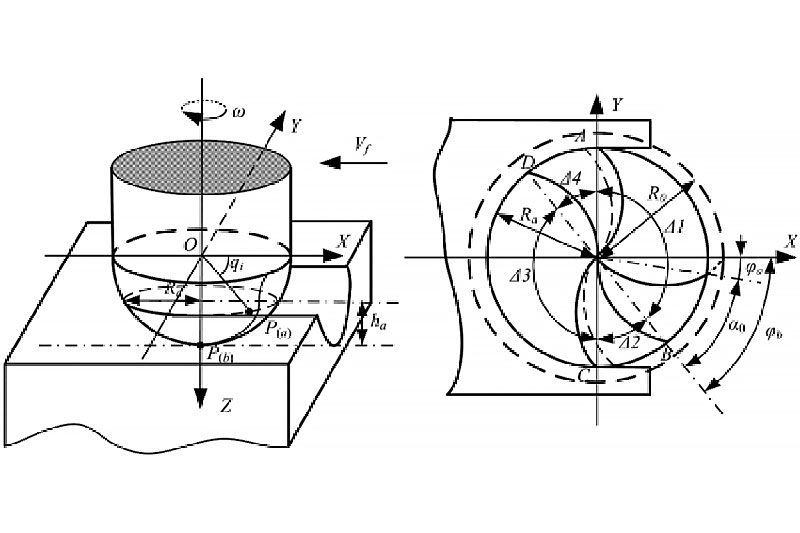
Cutting edge length affects how cutting forces are distributed during machining. Longer edges allow forces to be distributed more evenly over a larger area, which can reduce unit pressure.
However, an edge that is too long can result in uneven force distribution, leading to local overload and process instability. Optimal cutting edge length ensures even force distribution, minimizes the risk of vibration and enables stable machining.
Impact on chip evacuation
Cutting edge length has a significant impact on chip formation and removal. Longer edges generate more chips, which can cause difficulties in effective chip removal.
Inefficient chip removal leads to chip accumulation in the cutting zone, which can result in:
- increased friction and increased temperature,
- deterioration of surface quality,
- increased risk of tool damage.
Proper selection of cutting edge length, combined with the right geometry of chip grooves, improves chip removal and increases machining stability.
Optimizing cutting edge length
Selecting the optimal cutting edge length depends on several factors:
- the type of material being machined,
- the required depth of cut,
- the stability of the machine tool-shank-object-tool system,
- the required surface quality.
These parameters must be adjusted to the specific machining conditions to achieve maximum process efficiency.
| Type of machining | Recommended cutting edge length |
|---|---|
| Coarse machining | 2-3 x tool diameter |
| Semi-finishing machining | 1.5-2 x tool diameter |
| Finishing machining | 1-1.5 x tool diameter |
The right cutting edge length ensures the stability of CNC milling, improves machining performance, and affects tool life and surface quality. Optimizing this parameter requires an analysis of machining conditions and a compromise between different process requirements.
Optimizing tool geometry for high-performance HEM machining
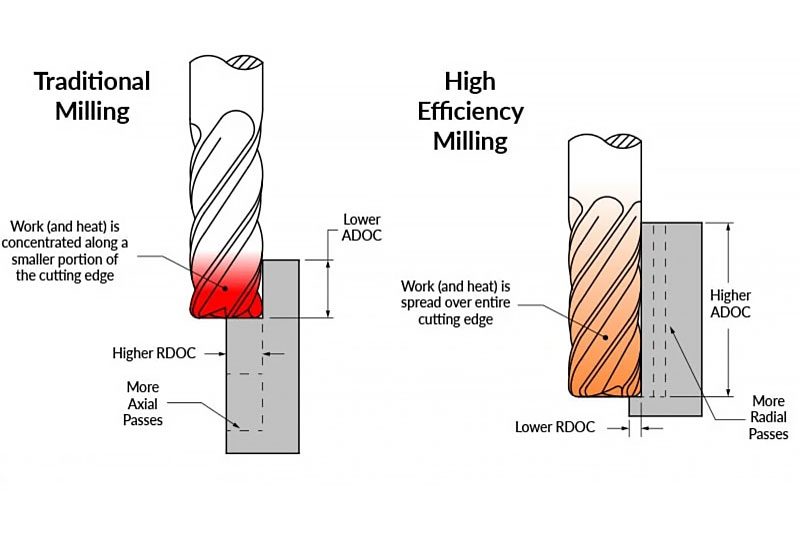
High Efficiency Machining (HEM) requires tools with specially designed geometries adapted to specific cutting conditions. Proper selection of tool parameters maximizes productivity and tool life in HEM processes.
Increased number of blades
In HEM tools, an increased number of blades plays a key role. Cutters equipped with 5, 6 or 7 blades are commonly used in this technique. Such a solution makes it possible to:
- Increased feed speed while maintaining the same chip thickness per blade.
- Better tool stability due to a larger core.
- More even distribution of cutting forces during machining.
A larger number of blades, combined with appropriate chip groove geometry, enables efficient chip removal. This is particularly important at the high cutting speeds characteristic of HEM.
Spiral angle optimization
The helix angle of HEM tools is larger than that of standard cutters. Typical values are in the range of 35-45 degrees. The larger spiral angle provides:
- Better chip evacuation, which reduces the risk ofchip accumulation in the cutting zone.
- Reduced cutting forces, resulting in less stress on the tool.
- Smoother blade entry into the material, which improves the stability of the machining process.
Interesting fact: Studies have shown that increasing the helix angle by every 5 degrees between 30°-45° can lead to a reduction in cutting forces of up to 3-5% when machining HEM stainless steel.
Special cutting edge geometry
The cutting edge geometry in HEM tools is designed for increased tool life and process stability. Key elements include:
- Variable rake angle along the cutting edge.
- Precisely controlled edge rounding, which reduces the risk of chipping.
- Microgeometry tailored to the specifics of HEM machining, which increases wear resistance.
The use of a variable rake angle allows optimization of the cutting process at different depths of cut. This is important in HEM, where large axial depths are used with small radial depths.
Optimized chip groove geometry
The chip grooves in HEM tools are designed for efficient removal of large amounts of chips generated at high cutting speeds. They are characterized by:
- Increased volume, which improves chip transport out of the cutting zone.
- A special shape that minimizes the risk of clogging.
- A low-friction surface, often coated with coatings that reduce chip adhesion.
Properly designed chip grooves reduce tool heating and improve tool life. They also allow the use of more aggressive cutting parameters.
Proper tool geometry in HEM technology improves the efficiency of the machining process. Optimization of the helix angle, number of blades and chip grooves allows the full potential of this technology to be realized, ensuring high surface quality and longer tool life.
Effect of chip groove shape on chip evacuation
The shape of the chip groove plays an important role in the CNC milling process, influencing the efficiency of chip removal and thus the productivity and quality of machining. The right groove geometry enables chips to be discharged smoothly from the cutting zone, ensuring process stability and high surface quality.
Chip groove geometry
Groove geometry includes several key parameters that affect its ability to evacuate chips:
- Groove spiral angle
- Depth of the groove
- Width of the groove
- Shape of the cross section
Each of these parameters affects the efficiency of chip transport and removal from the cutting zone. The optimal values depend on the type of material to be machined, cutting parameters and surface quality requirements.
Effect of the groove spiral angle
The helix angle of a chip groove affects the direction and speed of chip removal. A larger helix angle accelerates chip removal, which is beneficial when machining materials that generate long, continuous chips. However, too large an angle can weaken the core of the tool, reducing its rigidity.
For materials such as aluminum and copper that create long, continuous chips, cutters with a larger spiral angle are used, typically in the 35-45 degree range. For harder materials, such as tool steels, which form shorter chips, smaller spiral angles are recommended to increase tool stiffness.
Interesting fact: Studies have shown that increasing the helix angle of a chip groove by every 5 degrees in the 30°-45° range can improve chip removal efficiency by up to 10-15%, depending on the material being machined.
Optimizing groove depth and width
The depth and width of a chip groove affect the space available for chips. Greater depth provides more space for chips, which is advantageous for roughing and materials that generate large amounts of chips. However, excessive depth can weaken the tool structure.
Groove width affects the freedom of chips to move along the tool. Wider grooves facilitate chip removal, but can reduce the number of cutting edges around the periphery of the tool, which affects surface quality.
Optimizing these parameters requires a compromise between efficient chip removal and maintaining adequate tool stiffness.
Innovative solutions in chip groove design
Modern CNC milling technologies are leading to innovative solutions in chip groove design:
- Grooves with variable geometries – allow optimization of chip removal at different cutting depths.
- Grooveswith micro-structures – special textures on the surface of the grooves reduce friction and facilitate chip movement.
- Asymmetrical chip grooves – provide better chip evacuation under certain cutting conditions.
The use of state-of-the-art solutions significantly improves chip evacuation efficiency, especially in demanding conditions such as deep pocket milling and machining of hard-to-machine materials.
A properly designed chip groove affects tool life, surface quality and the overall efficiency of the CNC milling process. Geometry optimization requires consideration of many factors and adjustment of parameters to specific machining conditions.
Selecting cutter geometry for machining hard-to-machine materials
Machining hard-to-machine materials, such as titanium alloys, Inconel or hardened steels, requires a special approach to milling cutter geometry selection. A properly designed tool affects process efficiency, surface quality and tool life.
Optimizing the rake angle
When dealing with hard-to-machine materials, selecting the right rake angle is crucial. Cutters with a negative or slightly positive rake angle are often used. A negative angle increases the strength of the cutting edge, which is important when machining high-hardness materials. However, an excessively negative angle can lead to increased cutting forces and excessive heating of the tool.
For titanium alloys, cutters with a rake angle in the range of -5° to 5° are recommended, depending on the specific alloy and cutting conditions. For Inconel, the optimal values are between -10° and 0°.
Interesting fact: Studies have shown that using a variable rake angle along the cutting edge can increase tool life by up to 30% when machining nickel alloys.
Cutting edge geometry
When machining hard-to-machine materials, cutting edge geometry plays an important role in process stability and reducing tool wear. Milling cutters with a reinforced cutting edge and appropriate micro-geometry preparation are recommended.
For materials such as Inconel or titanium alloys, a cutting edge with a controlled rounding radius, usually in the range of 10-30 μm, is effective. This geometry increases chipping resistance and facilitates control of the chip forming process.
Optimizing chip groove geometry
Efficient chip removal is key to process stability and preventing premature tool wear. The geometry of the chip grooves should ensure fast and efficient chip removal from the cutting zone.
For materials such as titanium alloys and Inconel, cutters with deep and wide chip grooves are recommended. A larger chip space is important when machining materials that generate long, ductile chips.
For hard-to-machine materials, cutters with variable chip groove geometry along the tool axis are often used. This design improves chip breakage and chip evacuation, which increases the stability of the machining process.
Special design solutions
Modern tools for machining hard-to-machine materials use advanced design solutions to improve the performance and durability of cutters:
- Cutterswith variable blade pitch – reduce vibration and improve cutting stability.
- Tools with internal cooling channels – deliver coolant directly to the cutting zone.
- Variable-diameter cutters – allow optimization of cutting at different depths of cut.
Properly selected cutter geometry affects the efficiency of machining hard-to-machine materials. Optimization of tool geometry increases productivity, improves surface quality and extends tool life, resulting in greater process stability and lower operating costs.
The role of tool coatings in improving CNC milling performance
Tool coatings play an important role in improving CNC milling productivity. The right tool coating affects tool life, surface quality and overall machining process efficiency.
Increasing tool life
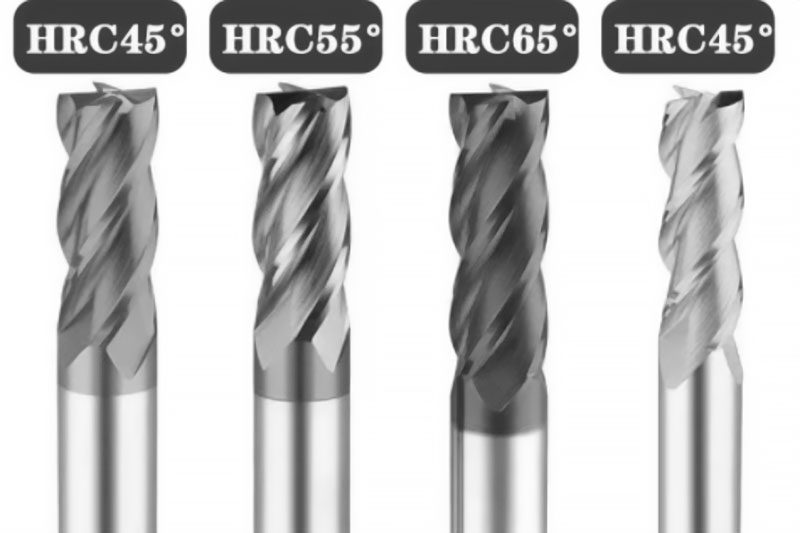
One of the main advantages of using tool coatings is to extend the life of cutting tools. Coatings form a protective layer, reducing abrasive and adhesive wear. As a result, tools last longer without the need for replacement or reconditioning.
TiAlN (titanium-aluminum nitride) and AlCrN (chromium-aluminum nitride) coatings show high resistance to wear and oxidation at elevated temperatures. This allows the use of higher cutting speeds and higher feed rates, resulting in increased productivity.
Interesting fact: Studies have shown that the use of AlTiN coating can increase tool life by up to 300% compared to uncoated tools when machining titanium alloys.
Improving the quality of the machined surface
Tool coatings have a significant impact on the surface quality obtained during CNC milling. By reducing friction between the tool and the workpiece, they lower cutting forces and temperatures in the machining zone.
Low-friction coatings, such as DLC (diamond-like carbon), improve surface quality by reducing build-up on the cutting edge. This is particularly important when machining hard-to-machine materials such as aluminum alloys and titanium.
Optimizing chip evacuation
The right tool coatings improve chip evacuation during CNC milling. Coatings with a smooth surface and low coefficient of friction facilitate chip movement, preventing chips from jamming in the cutting zone.
TiCN (titanium carbide) and AlTiN (titanium-aluminum nitride) coatings exhibit good sliding properties, increasing chip removal efficiency. This is particularly important when machining materials that form long, ductile chips, such as aluminum alloys and stainless steels.
Increase machining efficiency
The use of appropriate coatings makes it possible to increase cutting parameters, which affects machining efficiency. High-temperature resistant coatings, such as AlTiN or TiAlN, allow higher cutting speeds and higher feed rates.
Multilayer coatings, combining different materials, offer additional benefits. An example is TiAlN/AlCrN, where TiAlN provides high hardness and AlCrN improves oxidation resistance, enabling operation in extreme conditions.
The use of advanced tool coatings leads to:
- reduced machining time,
- reduced energy consumption,
- reduction of production costs,
- improvement in the quality of machined parts.
The development of tool coating technology opens up new opportunities to optimize CNC milling processes, contributing to the efficiency and competitiveness of manufacturing companies.
Influence of tool geometry on cutting forces and dimensional accuracy
The geometry of a cutting tool is important for cutting forces and dimensional accuracy of workpieces in CNC milling. Proper selection of geometric parameters affects machining performance, surface quality and tool life.
Effect of rake angle on cutting forces
The rake angle directly affects the magnitude of cutting forces. A larger positive angle reduces cutting forces, which reduces the load on the tool and machine tool. However, an excessive positive angle weakens the cutting edge, increasing the risk of chipping.
With hard-to-machine materials such as titanium alloys and Inconel, tools with a smaller or negative rake angle are often used. This increases the strength of the cutting edge, although at the expense of increased cutting forces.
Interesting fact: Studies have shown that changing the rake angle by each degree between -5° and 15° can lead to a change in cutting forces of up to 2-4%, depending on the material being machined.
The role of rake angle in shaping dimensional accuracy
The angle of application affects the dimensional accuracy of workpieces. An angle that is too small increases friction between the touchdown surface and the workpiece, resulting in increased temperature and thermal deformation of the tool.
On the other hand, too large a touchdown angle reduces friction but weakens the cutting edge, making it more susceptible to deformation under cutting forces. This can lead to dimensional errors in the workpiece.
The optimal angle of application depends on the type of material being machined and the cutting conditions. For hard materials, smaller application angles (6-8°) are usually used, while for soft materials, larger values (10-15°) can be used.
Effect of corner radius on dimensional accuracy
The corner radius affects dimensional accuracy, especially in finishing. A larger radius improves surface quality, but can hinder the reproduction of complex shapes.
A smaller radius allows more accurate forming of sharp edges and corners, but increases cutting forces in these areas. Choosing the right corner radius is a compromise between surface quality and dimensional accuracy.
Optimizing tool geometry for improved dimensional accuracy
Optimization of tool geometry requires consideration of geometric parameters and their interrelationships and effects on cutting forces. Modern tools often have variable geometry along the cutting edge to adapt the cutting process to different machining conditions.
Effective solutions include:
- use of variable rake angle along the cutting edge,
- use of micro-geometry to improve cutting stability,
- optimal selection of the combination of rake and clearance angles,
- use of modern tool coatings that increase tool life.
Properly selected tool geometry makes it possible to control cutting forces and achieve high dimensional accuracy in the CNC milling process. This requires a detailed analysis of the machining conditions, the properties of the material to be machined, and the specific requirements for part quality and accuracy.
Summary
Tool geometry plays an important role in CNC milling, affecting machining performance, surface quality and tool life. Appropriate geometric parameters, such as rake angle, angle of application, number of blades or shape of chip grooves, enable optimization of cutting under different conditions and for different materials.
Adapting tool geometry to the specifics of machining hard-to-machine materials and using advanced coatings increase process efficiency. State-of-the-art solutions, such as milling cutters with variable geometries or specially prepared cutting edge microgeometries, enable higher precision and higher productivity.
Optimization of tool geometry affects cutting forces, chip removal and dimensional accuracy of workpieces. Proper selection of these parameters increases the efficiency of CNC milling, reducing production costs, improving the quality of finished components and strengthening the competitiveness of manufacturing companies.
Sources:
- https://en.wikipedia.org/wiki/End_mill
- https://academic.oup.com/jcde/article/9/5/2024/6713622
- https://en.wikipedia.org/wiki/Milling_cutter
- https://www.researchgate.net/publication/273479813_The_Influence_of_Milling_Tool_Geometry_on_the_Quality_of_the_Machined_Surface
- https://en.wikipedia.org/wiki/Cutter_locationhttps://www.mdpi.com/2227-7390/9/12/1360
- https://journals.sagepub.com/doi/abs/10.1177/16878140211004771
- https://www.tandfonline.com/doi/full/10.1080/21693277.2015.1094756
- https://en.wikipedia.org/wiki/Milling_machine